

For years, higher education has approached online teaching in two main ways. First, online courses are often viewed as a lesser form of higher education, an inferior member of the higher education family. Second, teaching online is frequently thought to require a specialized degree, a unique skill set, or a level of technological expertise that most faculty members simply don’t have the time to develop. Workshops promise “best practices,” institutions invest in new platforms, and faculty often prepare for what feels like an entirely new way of teaching. But here’s the irony: after the syllabus is posted, the modules are prepared, and the course goes live… success in online teaching depends on something much simpler, and much more human. It’s not fancy tools. It’s not perfect videos. It’s not rocket science. It’s presence. It’s responsiveness. It’s an interaction.
Decades of research point to the same truth: students in online courses don’t need flawless course design nearly as much as they need an instructor who shows up. When faculty engage consistently—checking in, responding with warmth, joining discussions, offering encouragement, and letting students know someone is truly on the other end—student success rises dramatically. Retention increases. Trust builds. And the sense of “online learning loss” begins to fade.
Yet this simple reality is still the most overlooked. Institutions continue to invest heavily in architecture while neglecting the human touch. Faculty are often trained in technology but not in connection. Students navigate gorgeous course shells but rarely encounter the person behind them.
To ensure the success of an online course, fully commit. Arrive early, participate often, and engage with purpose. Everything else takes a backseat. Online teaching is not just about navigating the digital world; it’s about mastering the art of connecting as a human being within a Digital space. And that’s something every faculty member can accomplish.
Ten Steps to Success in Online Teaching
As a disclaimer, the mention of rocket science is not meant as a critique of faculty who teach online. However, there are some fundamental actions faculty can take to improve their teaching success and foster student learning, as shown in Figure 1.
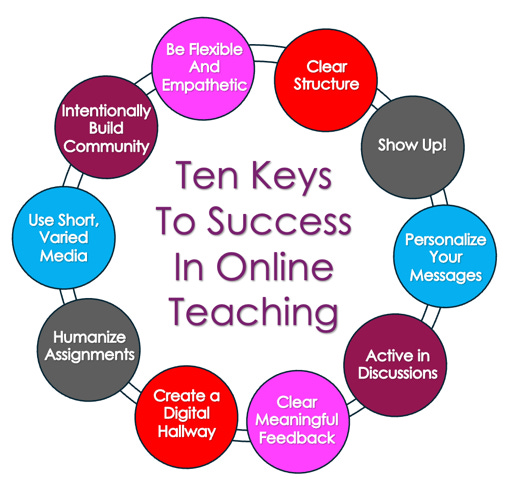
Here are ten evidence-based strategies to consider:
1. Show up.
Post a welcome video, send a day-one message, and check in several times a week so students feel your presence from the start (Caskurlu et al, 2020; Chickering & Ehrmann, 1996; Glazier & Harris, 2021; Martin et al, 2022; Neel, 2025; Richardson, 2017; Topić, 2022). These practices send a clear indication that you “are there, and you care” (Mastel-Smith et al. 2015).
2. Use warm, personalized communication.
Call students by name, respond with encouragement, and craft messages that sound like a human, not a syllabus (Meredith, 2024; Pritts, 2023). Remember this proposal by Dale Carnegie: “Remember that a person’s name is to that person, the sweetest and most important sound in any language”. Capitalize on that reality.
3. Provide a clear, predictable structure.
Organize modules consistently, reduce cognitive load, and ensure students always know what to do next (Berro, 2024; Cooney, 2020). Course design should promote student ease of learning, not serve as a source of frustration.
4. Be active in discussion spaces.
Ask probing questions, acknowledge good ideas, and model high-quality responses to elevate thinking (Aloni & Harrington, 2018; Xie & Correia, 2023). This involvement, once again, shows that you are present. Participation in discussions, whether synchronous or asynchronous, is a great way to promote critical thinking and the exchange of ideas.
5. Offer timely, meaningful feedback.
Return work quickly with comments that affirm, guide, and challenge—feedback is one of the strongest engagement levers (Barboza & Silva, 2017; Esterhazy, 2019; Jensen et al. 2023). Students appreciate personalized and detailed feedback delivered in a timely manner.
6. Create a “digital hallway.”
Use short check-ins, informal announcements, and quick video/voice notes to replicate the relational cues of in-person hallways (Davis et al. 2025; Kaufmann & Vallade, 2020). Take a minute to text or email a student and provide words of encouragement on their participation in the course.
7. Humanize assignments.
Invite students to connect content to their lived experiences, interests, or career goals to increase relevance and motivation (Pacansky-Brock et al. 2020; Stewart, 2024). It is worth noting that learning in higher education prepares students for life after graduation. Including relevant content that relates to the “real world” helps students make connections and sharpen their focus on their personal and professional lives.
8. Use short, varied media.
Break lectures into 6–10-minute chunks, mix text with visuals, and include brief demos or examples to maintain attention (Amaka et al., 2017; Kobayashi, 2017). This enables students to engage in microlearning (Garner et al., 2025), utilizing their smartphones or tablets in a convenient manner to interact with course content.
9. Build community intentionally.
Utilize icebreakers, peer reviews, group activities, and rotating “student spotlight” prompts to help students feel seen by one another (Snyder & Garner, 2020). It is easy for online learners to feel isolated, learning independently. Offering community-building activities lessens that sense of isolation.
10. Stay flexible and empathetic.
Offer reasonable grace, alternative formats, and space for students to navigate life—flexibility is engagement (Cartee, 2021; Snyder & Garner, 2022). In their lives outside the learning management system, students face real everyday challenges. Demonstrating empathy and concern creates connections that students appreciate.
Which of these practices are common to the online courses that you teach?
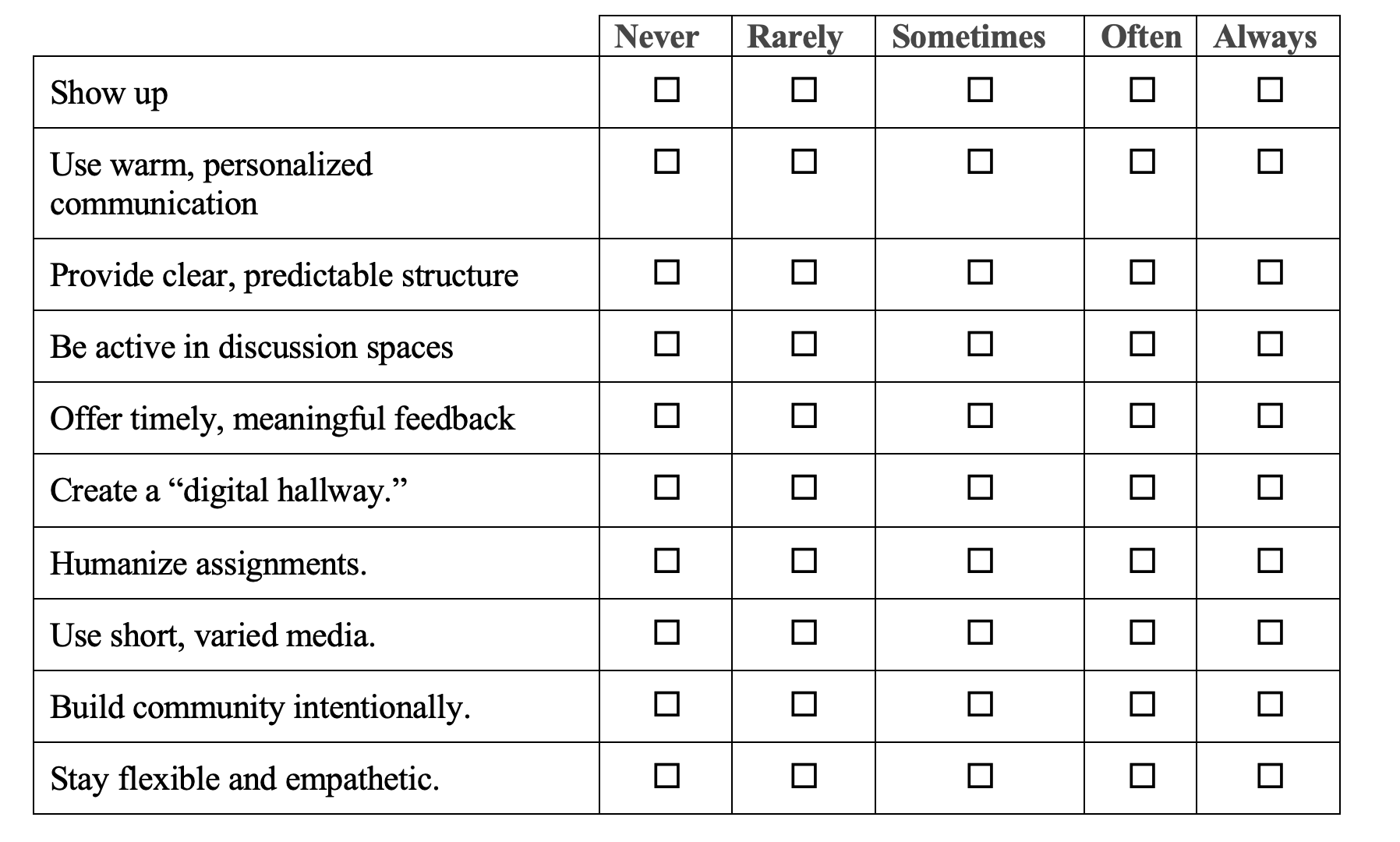
Some questions for reflection:
How am I intentionally showing my presence and humanity online—through my tone, check-ins, feedback, and participation—so students feel there is a real, caring person on the other side of the screen?
In what ways does my course structure (modules, deadlines, communication patterns, types of media, assignment design) help reduce student anxiety and create a predictable, supportive learning rhythm?
How am I cultivating community and connection—through discussions, digital hallway moments, flexible policies, and empathy—so students feel seen, valued, and supported in their learning journey?
A challenge:
Try these identified elements in the next online course that you teach and observe the reactions and feedback you receive from students.
References
Aloni, M., & Harrington, C. (2018). Research-based practices for improving the effectiveness of asynchronous online discussion boards. Scholarship of Teaching and Learning in Psychology, 4(4), 271–289. https://doi.org/10.1037/stl0000121
Amaka, I. H., Goeman, K., & Leuven, K. (2017). (PDF) Selecting media for effective learning in online and blended courses: A review study. LearnTechLib. https://www.researchgate.net/ publication/325382136_Selecting_Media_for_Effective_Learning_in_Online_and_Blended_Courses_A_Review_Study
Barboza, E., & Silva, M. (2017, October 12). The importance of timely feedback to interactivity in online education. ifip. https://ifip.hal.science/hal-01615694/
Cartee, J. (2021). Strategic Empathy in Virtual Learning and Instruction: A Contemplative Essay about Teacher-Student Rapport during Times of Crisis, 10, 12–19. https://files.eric.ed.gov/fulltext/EJ1314158.pdf
Caskurlu, S., Maeda, Y., Richardson, J. C., & Lv, J. (2020). A meta-analysis addressing the relationship between teaching presence and students’ satisfaction and learning. Computers & Education, 157, 103966. https://doi.org/10.1016/j.compedu.2020.103966
Charles, J. (2023, August 31). The art of personalization: Communicating effectively in higher education. The EvoLLLution. https://evolllution.com/attracting-students/marketing_branding/the-art-of-personalization-communicating-effectively-in-higher-education
Chickering, A., & Ehrmann, S. C. (1996). (PDF) implementing the Seven principles: Technology as Lever. AAHE Bulletin. https://www.researchgate.net/publication/246430027_ Implementing_the_Seven_Principles_Technology_as_Lever
Cooney, R. L. (2020, June 16). Consistency and predictability as principles for course design. MEHP. https://improvinghealthcare.mehp.upenn.edu/resource/consistency-and-predictability-principles-course-design
Davis, J. T., Sondreal, A. P., Bauer, F., & Cornelius, J. T. (2025). From anonymity to engagement: The benefits of early-semester student-instructor meetings. Advances in Physiology Education, 49(3), 605–610. https://doi.org/10.1152/advan.00040.2025
Esterhazy, R. (2019). Re-conceptualizing feedback through a sociocultural lens. In M. Henderson, R. Ajjawi, D. Boud, & E. Molloy (Eds.), The impact of feedback in Higher Education: Improving Assessment Outcomes for Learners (pp. 67–82). essay, Palgrave Macmillan.
Garner, B., Els, A., & Snyder, T. (2025). Microlearning strategies: Engaging online adult learners.” Advances in Online Education: A Peer-Reviewed Journal 4(2), 1-18.
Glazier, R. A., & Harris, H. (2021). Instructor presence and student satisfaction across modalities: Survey data on student preferences in online and on-campus courses. International Review of Research in Open and Distributed Learning, 22(3), 77–98. https://doi.org/10.19173/irrodl.v22i3.5546
Kaufmann, R., & Vallade, J. I. (2020). Exploring connections in the online learning environment: Student perceptions of rapport, climate, and loneliness. Interactive Learning Environments, 30(10), 1794–1808. https://doi.org/10.1080/10494820.2020.1749670
Kobayashi, M. (2017). Students’ media preferences in online learning. Turkish Online Journal of Distance Education, 4–4. https://doi.org/10.17718/tojde.328925
Martin, F., Wan, L., & Wu, T. (2022). A meta-analysis on the Community of Inquiry presences and learning outcomes in online and blended learning environments. Online Learning, 26(1), 325–359.
Mastel-Smith, B., Post, J., & Lake, P. (2015). Online teaching: “Are you there, and do you care?” Journal of Nursing Education, 54(3), 145–151. https://doi.org/10.3928/01484834-20150218-18
Meredith, S. (2024, October 1). Naming students is even more crucial in online classes. THE Campus Learn, Share, Connect. https://www.timeshighereducation.com/campus/naming-students-even-more-crucial-online-classes
Neel, J. (2025, May 29). What Online Teaching Taught Me About Showing Up (Even When No One Else Does). Medium. https://medium.com/knowlobby/what-online-teaching-taught-me-about-showing-up-even-when-no-one-else-does-9a7494e70892
Pacansky-Brock, M., Smedshammer, M., & Vincent-Layton, K. (2020, June 18). Humanizing online teaching to Equitize Higher Education. Current Issues in Education. https://cie.asu.edu/ojs/index.php/cieatasu/article/view/1905
Pritts, N. (2023, September 6). How to be conspicuously human in the online classroom . Faculty Focus | Higher Ed Teaching & Learning. https://www.facultyfocus.com/articles/online-education/online-course-delivery-and-instruction/how-to-be-conspicuously-human-in-the-online-classroom/
Richardson, J. C., Maeda, Y., Lv, J., & Caskurlu, S. (2017). Social presence in relation to students’ satisfaction and learning in the online environment: A meta-analysis. Computers in Human Behavior, 71, 402–417. https://doi.org/10.1016/j.chb.2017.02.001
Snyder, T., & Garner, B. (2020, November 18). Engaging faculty to connect with online learners in real-time. Retrieved November 18, 2020, from https://er.educause.edu/blogs/2020/11/engaging-faculty-to-connect-with-online-learners-in- real-time
Snyder, T., & Garner, B. (2022). Empathy in online education. The Teaching Professor, January 24, 2022, teachingprofessor.com/topics/online-teaching-and-learning/empathy-in-online- education
Stewart, O. G. (2024). Understanding what works in Humanizing Higher Education Online Courses. Issues and Trends in Learning Technologies, 11(2). https://doi.org/10.2458/itlt.5566
Topić , A. A. (2022, October 31). Examining students’ interaction and satisfaction with online learning: Map Education and humanities. MAP Education and Humanities - Journal. https://mapub.org/mapeh/3-1/examining-students-interaction-and-satisfaction-with-online-learning/
Xie, J., & Correia, A. (2023). The effects of instructor participation in asynchronous online discussions on student performance: A systematic review. British Journal of Educational Technology, 55(1), 71–89. https://doi.org/10.1111/bjet.13350


